
Your staff already carry a barcode scanner
The second till never gets a scanner, because a scanner is eighty pounds you have not spent. Everyone behind the counter is already holding one.
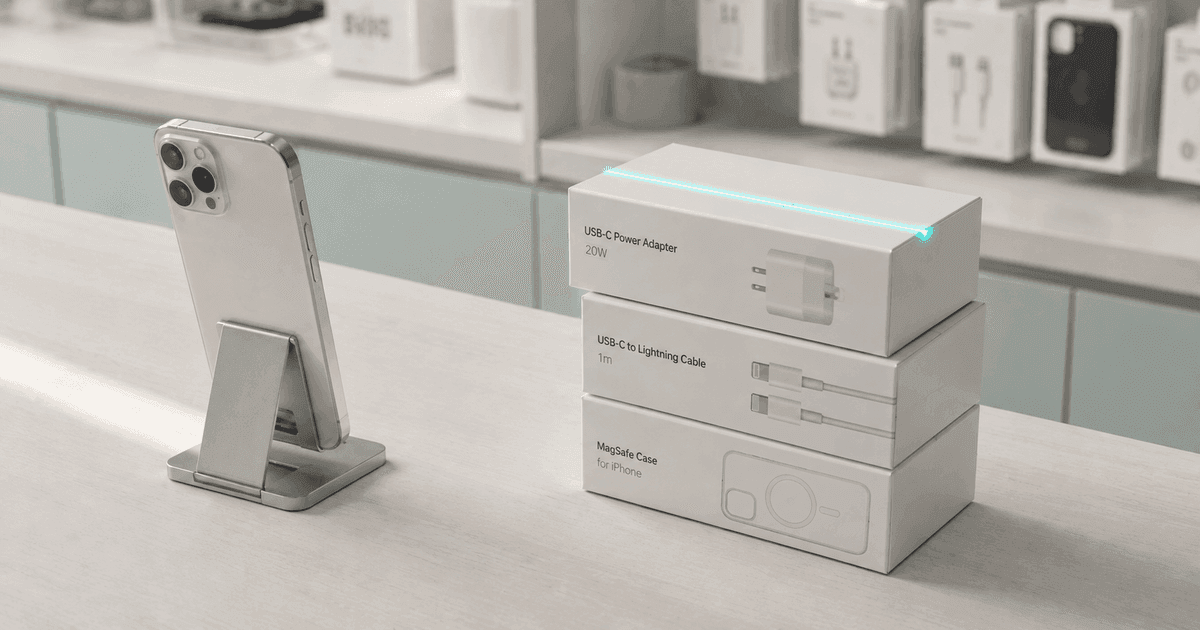
Most repair shops own exactly one barcode scanner, and it lives at whichever till used it last.
That is not a purchasing failure. A scanner is never urgent enough to buy today and never cheap enough to buy four of, so the shop settles into a rhythm: one counter scans, the other types SKUs, and the stock delivery on the floor is counted by carrying boxes to the desk the cable reaches.
Meanwhile there are four phones behind the counter, each with a camera better than the scanner.
Why "just use the phone" usually is not that simple
Plenty of people have had this idea. The reason it does not normally work is not the camera — phone cameras decode barcodes perfectly well — it is everything around it.
To scan into a sale, the phone has to know which sale. Which means it has to be signed in as somebody. Which means an app, an account for every member of staff, a password nobody remembers, and a device you now have to think about when someone leaves.
At which point the £80 scanner looks like the cheap option, because it is.
Pairing beats logging in
The move that makes it work is to stop treating the phone as a user and start treating it as a peripheral.
A peripheral does not log in. It gets connected to one till, for one session, and it stops being connected when the session ends. That is what a cable does, and it turns out you can do the same thing with a code on a screen.
The till shows a QR. A phone scans it. That phone is now attached to that till's open sale, and to nothing else. No account was created and nothing was installed.
Four properties make that safe, and they are worth checking on any implementation:
The code expires. A pairing code left on a screen at lunchtime should be useless by the time someone finds it. Minutes, not hours.
The session expires too. Separately, and on a hard ceiling. A phone forgotten in an apron pocket must stop being a till after a while whatever it is doing.
One code, one phone. A pairing code that can be claimed twice is a pairing code that can be photographed.
The till can cut it off. Disconnect, and finishing the sale, should both end it immediately.
What the phone should be allowed to do
This is where it is worth being precise, because the whole value of the idea is that you can hand the phone to whoever is standing there — the Saturday assistant, the new starter, the person helping out during a rush.
Let it scan, change a quantity, and remove a line. That is what a second pair of hands actually needs.
Do not let it price or take money. Discounting, overriding a price and taking payment are decisions with a role attached, and that role belongs to whoever is on the till, not whoever is holding a phone.
And be honest about what it displays. A phone scanning into a sale shows the sale — the lines, the prices, the total. It has to; the person holding it is reading items out. The meaningful question is not whether it shows prices, it is what it never receives at all: what those items cost you, your margin, who supplies them, the customer's name and number, and complete serial numbers. Those are the things you would not want written down on a bus, and none of them need to leave the till for a barcode to be scanned.
The cases it actually solves
Not "replacing scanners". These:
- The second counter, which has never had one and never will.
- The delivery on the floor, which is nowhere near the desk.
- The busy Saturday, where an extra person is worth more than an extra till.
- The pop-up or the market stall, where the hardware is whatever fits in a bag.
If your shop has one counter and a scanner already cabled to it, this changes nothing for you, and that is fine. Keep the scanner. A good USB scanner is fast, dumb and reliable, and any system worth using should accept one — they behave like keyboards, so it is not much of an ask.
The thing to check before you rely on it
Signal. A phone that loses the till mid-sale must say so and stop, not quietly collect scans nothing will ever read. Ask what happens on a dropped connection: the honest answer is that scans are numbered and acknowledged, so reconnecting catches up on exactly what was missed. The dishonest answer is silence, and you will find out on the busiest afternoon of the year.
How pairing, expiry and the split of authority work in SlickCell Pro is on Phone scanner.