
A till that keeps the money straight, not just the sale
Most tills are good at taking a payment and bad at saying what kind of money it was. Part payments, change and store credit are not the same thing, and a shop that treats them as one loses the difference.
Where the money quietly changes shape
Every one of these balances on the day and still leaves you short at the month.
A customer pays most of it, promises the rest, and the sale gets marked paid.
The shortfall is written off as a discount because that is the only field that fits.
Cash change handed back is counted as though it were takings.
Store credit from a return is given as a price reduction, so the liability disappears.
A handset is sold from a shelf that the system still thinks holds four.
A refunded device goes straight back out for sale without anyone checking it.
From the exact unit to a settled balance
The sequence matters because each step is where a specific mistake usually happens.
- 01Exact unitThe specific item or handset, not a generic line.
- 02BasketPriced and totalled — stock is not touched yet.
- 03Split tenderCard, cash or store credit, in any combination.
- 04Balance stateReceived, due, overpayment and change kept apart.
- 05ConfirmOnly now does stock move against the sale.
- 06ReceiptThe document carries the same figures as the ledger.
The order is deliberate: nothing leaves the shelf on the strength of someone starting a sale, and nothing is called paid until the arithmetic says it is.
One sale, settled two ways
The screen where the distinction between received, due and change is either kept or lost.
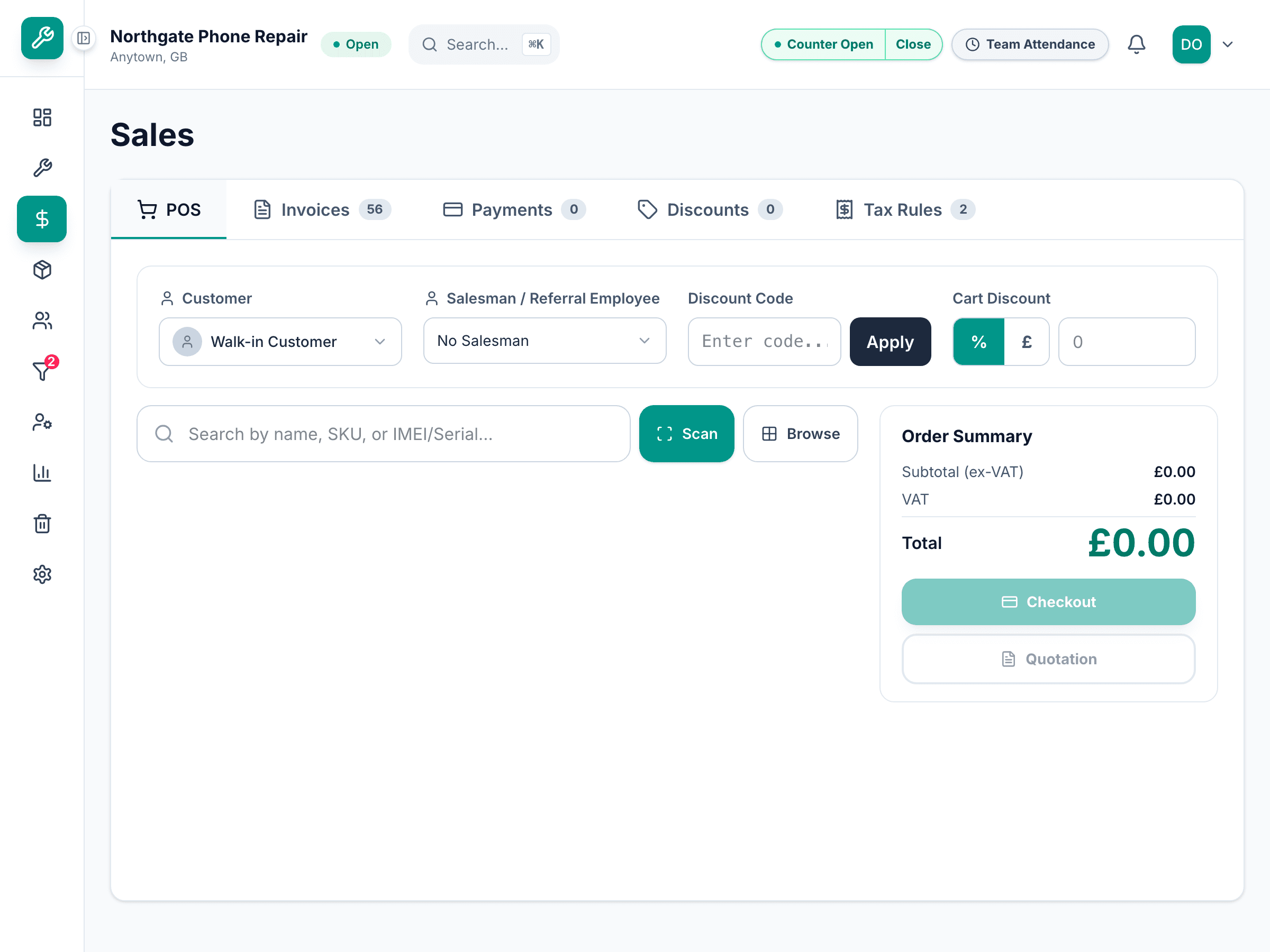
Card and cash on the same sale, both classified
The total due, the amount collected and what is left are three separate figures, not one field called paid. Each tender line carries its own method and reference, so the cash drawer and the card total can both be reconciled at close — and a shortfall stays visible as a balance instead of quietly becoming a discount.
Split payments across cash, card, bank transfer and store credit.
What the counter stops costing you
These are the five leaks that a till which only knows paid and unpaid cannot close.
- Shortfalls stay visible
- An underpayment is a balance you can chase, not a discount you absorbed.
- Change is not takings
- Cash handed back is never reported as revenue, so the day's figure is real.
- Credit stays a liability
- Store credit moves on a ledger instead of vanishing into a price reduction.
- Stock matches the shelf
- Nothing is deducted because a sale was started — only because one completed.
- Returns are decided
- Where returned stock goes is chosen, not assumed, and it is not resold unchecked.
The rules the till actually enforces
Not settings you have to remember. This is how the sale behaves.
- The exact item is selected
- You sell the specific part, or the specific handset by its IMEI, serial or shop reference — never a generic line that stands in for whichever one happens to be on the shelf.
- The basket does not touch stock
- Adding an item to a sale reserves nothing and deducts nothing. A half-started sale at a busy counter cannot make your stock figures wrong.
- Stock moves on confirmation
- The shelf changes only when the sale reaches its confirmed, approved state — one movement, at one moment, with a record attached.
- Five figures, kept apart
- Amount received, invoice total, amount due, overpayment and change are five separate numbers. Collapsing them into one is exactly how shortfalls disappear.
- Underpayment is never a discount
- Paying less than the total creates a visible balance against the sale. There is no path where a shortfall silently becomes a price reduction.
- Change is not revenue
- Cash given back is recorded as change, not as money taken, so the day's revenue figure is not inflated by the float moving in and out.
- Store credit is a ledger movement
- Credit issued and credit spent are entries on a ledger you can read back — a liability the shop owes, rather than a discount that leaves no trace.
- Returned stock has a destination
- On a refund you choose deliberately where the item goes. It does not default back onto the sales shelf because that was the easiest option.
- Refunded devices are not automatically resellable
- A returned handset does not become sellable stock again until it has been inspected. The system will not quietly put an unchecked device back in the window.
What the till carries
Sell the exact unit
Repairs, accessories and individual handsets on the same sale, each identified.
Split tender
Card, cash, bank transfer and store credit in any combination on one sale.
Balance arithmetic
Received, total, due, overpayment and change tracked as separate figures.
Store credit ledger
Credit issued and spent as recorded movements, not as invisible discounts.
Controlled returns
Refunds choose where stock goes, and devices need inspection before resale.
Receipt from the sale
The document is produced from the sale record, so the two cannot disagree.
What counter staff ask first
Starting with the one that matters most at a queue.
A sale is a few taps either way. The time a shop actually loses is at the month end, reconciling a till that recorded a part payment as paid and a shortfall as a discount. This is the same speed at the counter and considerably faster afterwards.
No. Stock changes only when the sale is confirmed. A basket that is abandoned, edited or left open at a busy counter has no effect on your stock figures at all.
The difference stays as a visible balance against the sale. It is never converted into a discount, so you can see what is owed, chase it, and settle it later against the same record rather than a new one.
Change is recorded as change and never counted as revenue. Amount received, invoice total, amount due, overpayment and change are five separate figures, so the day's takings reflect money kept rather than money handled.
It moves on a ledger. Credit issued is a liability the shop owes and credit spent is an entry against it, so you can read back what was given and what has been used — rather than a price reduction that leaves no trace.
Not automatically. You choose where returned stock goes, and a returned device is not treated as sellable again until it has been inspected. That stops an unchecked handset going back in the window on a busy afternoon.
See a split-payment sale end to end
Card and cash on one sale, a shortfall left as a balance, and a refund that decides where the stock goes — on your own products.