
What you ordered, what turned up, and what you owe for it
Three numbers that should always agree and usually do not. An order, a delivery and a bill are separate events — this keeps them attached to each other so the difference is visible the day it happens, not at year end.
Where an order and its stock come apart
None of this is carelessness. It is what happens when the order lives in a message thread and the stock lives in a spreadsheet.
An order is placed over WhatsApp and nobody else in the shop can see what was ordered.
Half the delivery arrives; the rest is remembered by one person until they are off sick.
Stock is booked in at the old price, so margin looks better than it is.
A supplier invoice arrives and nobody can tell which delivery it is for.
A faulty part goes back to the supplier and is never credited.
The same part is ordered twice because the first order was never recorded.
Order, receive, bill, settle
Each step is a record that points at the one before it, so the trail from order to payment stays intact.
- 01RaiseA purchase order against a supplier, with the lines and costs you expect.
- 02SendThe order leaves as a document the supplier can work from.
- 03ReceiveBook in what actually arrived — the whole order or part of it.
- 04CostReceiving recalculates the moving-average cost of what you now hold.
- 05BillThe supplier bill is the payable, raised against the receipt.
- 06PayPayments settle against the bill, so the outstanding balance is real.
- 07ReturnFaulty or wrong stock goes back on a record, not on trust.
Because receiving is what moves stock and sets cost, the shelf, the cost of goods and the supplier balance all change from the same event.
A part order, all the way through
The records a stockroom actually works from.
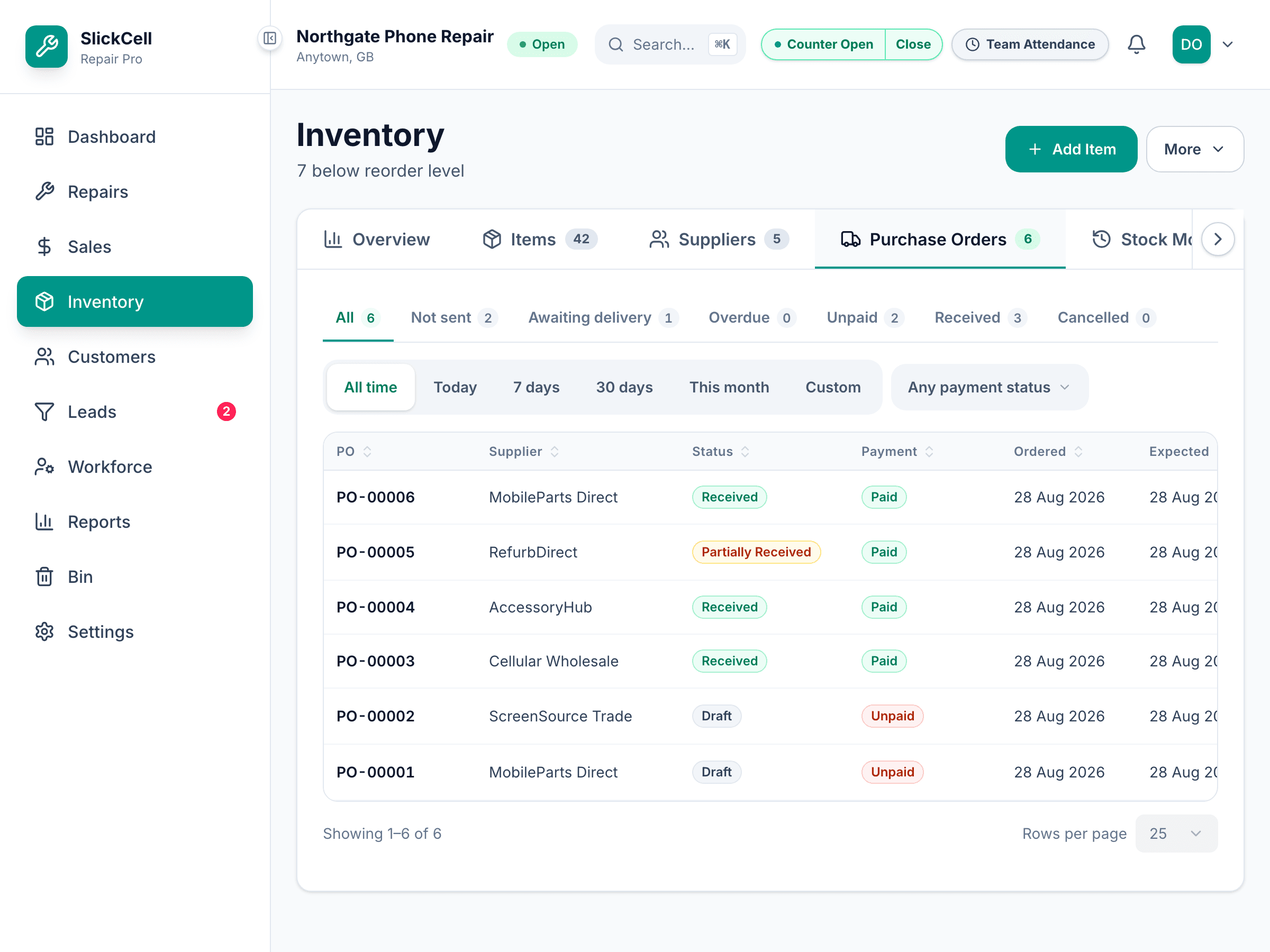
Receive six of the ten you ordered
Book in the quantity that arrived, line by line. The order stays open on the remainder and says so — Partially Received is its own state, not a note in a comment box. When the rest turns up, it is received against the same order.
A part-delivered order stays open on exactly what is still owed.
Total Revenue
£593.80
Invoiced (accrual basis) · all channels
4
Completed
£148.45
Per transaction
Today · 23 Jul 2026 · 4 invoices
- INV-00048Repair£124.80View detailsHannah Vogel · paidtax £20.80 · paid £124.80
- INV-00049Sale£54.00View detailsMarcus Adeyemi · paid-£6.00 · tax £9.00 · paid £54.00
- INV-00050Repair£96.00View detailsRachel Okonjo · partially_paidtax £16.00 · paid £60.00
- INV-00051Sale£319.00View detailsTomas Novak · paidtax £14.00 · paid £319.00
-£6.00 · tax £59.80 · paid £557.80
Margin based on what you actually paid
Receiving recalculates the moving-average cost of the stock you hold, so a price rise reaches your margin the moment it reaches your shelf. The old cost does not linger, and the profit report does not flatter you.
Cost changes on receipt, not the next time somebody edits the part.
The supply chain stops being a memory test
- One place to look
- What is on order, what is part-delivered and what is still owed — visible to anyone on the counter, not just whoever placed the order.
- Supplier balances that are real
- Bills are the payable and payments settle against them, so an outstanding figure is something you can act on.
- Returns that get credited
- Stock sent back to a supplier is a record with a state, so it can be chased.
- Costs that stay honest
- Receiving sets cost. Margin reflects the price you actually paid for the stock you actually hold.
Every SlickCell feature is included on every plan — plans differ by team size, locations, discounts and support.
The awkward ones, handled
Ordering is easy. It is the exceptions that decide whether a system survives contact with a stockroom.
- Only part of the order arrives
- Receive the lines that came. The order moves to Partially Received and keeps the outstanding quantity, so it can be chased on what is actually missing.
- The rest is never coming
- An order can be closed short without destroying the record of what was ordered — the history of the shortfall survives.
- The price changed between order and delivery
- The receipt carries the cost you were actually charged, and the average cost of your stock moves with it.
- The bill covers more than one delivery
- A bill is its own record raised against what was received, rather than being forced to match one order exactly.
- Stock arrives faulty
- It goes to a return record against the supplier rather than onto the shelf, and stays visible until it is credited.
- A refunded item comes back from a customer
- It lands in a holding area marked used — never straight back into sellable stock. Inspect it, then restock it as used or send it back to the supplier.
- Two people order the same part
- Open orders are visible to the shop, not private to the person who raised them.
None of these need a workaround. They are states the records already carry.
What purchasing carries
Purchase orders
Raise an order against a supplier with the lines and costs you expect to pay.
Line-level receiving
Book in what arrived, line by line, and leave the order open on the rest.
Goods received notes
A receipt is its own record — what came, when, and against which order.
Supplier bills
The bill is the payable. Payments settle against it, so outstanding means outstanding.
Returns to supplier
Faulty and wrong stock goes back on a record that stays open until it is credited.
The trail stays joined
Order, receipt, bill and payment each point at the one before it.
What stockroom managers ask
The number of suppliers is not what makes ordering go wrong — part-deliveries, price changes and uncredited returns are, and those happen with three suppliers as easily as with thirty. If your orders already reconcile perfectly, this will feel like paperwork. If you have ever paid for stock that never arrived, it will not.
No. Receiving sets what the stock COST you, and recalculates the moving average across what you hold. Selling prices are yours to set and are never moved for you.
Yes. A bill can be posted on its own, because real supplier invoices do not always map neatly onto one order. It is still a payable that payments settle against.
Close it short. The order keeps the record of what was ordered and what arrived, so the shortfall stays visible rather than being erased to tidy the list.
If your supplier also uses SlickCell Pro, yes — you can order against a catalogue they keep current, and they run their own orders, dispatch and discrepancies from their side. For everyone else, an order is a document you send them.
Bring one supplier and one order
We will run it end to end — raise it, part-receive it, bill it and settle it — against your own parts and costs.